Overall I have found this project both challenging at times
yet also really rewarding. To begin with I was quite unsure how and where I felt
this project was going however the more research I collected and tasks we
completed the easier I found it to create and envision new ideas about where I felt
the project was going. In my opinion the turning point in my process of
collecting ideas came about when I began researching modern hairstyles with Elizabethan
features and I came across catwalk collections from a variety of designers and
their models appeared to have hairstyles that were heavily inspired by
Elizabethan styles. When finding these it allowed me to think of how I would
interpret Elizabethan hairstyles and another important part in the progression
of my ideas came when we began looking at bridal hairstyles and I came across
the waterfall braid. I thought this specific style of braid was beautiful and
loved how simple it was to create such a beautiful piece in someone’s hair. The
combination of these two factors allowed me to develop and produce a variety of
ideas that eventually turned into my final idea that I wanted to use for my
outcome. Once I had done this it was time to swap ideas with my partner and
begin our practice, it was really nice being assigned a partner as she was
someone I hadn’t really spoken to before but we found that we got on really
well and really well together. At first we both found each other’s designs
quite difficult however the more we practiced the easier we found it. I think
my partner execute my design really well and even though I would have liked it
slightly differently I still believe she did an amazing job. Even though I had
done plenty of practice and tried my best I was quite unhappy with how I executed
my partners design, as I know I could’ve done better as it had done during some
of our practices. I feel that I may have put myself under too much pressure on
the day and that if I had relaxed it may have gone better. However I know for
next time what I would do differently and how I can improve. All in all I have
loved the challenging aspects of this project and found it really interesting
to look at some of the historical aspects of hairstyles and how it has
influenced modern fashion trends.
Showing posts with label Technical File. Show all posts
Showing posts with label Technical File. Show all posts
Sunday, 29 November 2015

Friday, 27 November 2015
Final Images and Evaluation - My Partner's Design and My Assessment


In general I found this creating and executing my partners design a lot more difficult than I had first anticipated. Her design was really beautiful and we both knew from the beginning that there was one aspect of her design that I would find really difficult to replicate, this was the roses that she wanted around her hairline. From our first practice session together we began trying out different ways to make these roses, using google and asking Lottie for her help and advice, Lottie’s advice was the best and most helpful and her process of making the roses is the one we chose to use and move forward with. The process involved taking two even segments of hair and coating them completely in hairspray, waiting for it to dry slightly and then slowly teasing a pair of straighteners over the two segments individually. This made the two segments extremely hard and stiff, yet I was still able to shape them into the shapes that I wanted. I rolled one up in a spiral shape and gripped these into place and then wrapped the other side in the opposite direction to the spiral and then gripped this firmly into place and set it using a lot of hairspray. Repeating this all along the hairline for each rose. During my practices I seemed to get better at this and found the outcome was better each time, however during the assessment for some reason I found it really difficult and struggles greatly in creating the roses. I think it may have been due to stress and worry, as I was rather stressed about this assessment piece. After spending a lot longer than I intended on the roses I decided it would be best if I left them to set and came back to them closer to the end, to make any finishing touches and hopefully fix them slightly. I then moved onto crimping my partner’s hair. In her design she wished for her hair to be really smooth from the roots until the top of her ears, where she wished for the crimping to start. I found the crimping part of this design really easy as I just needed to section the hair and crimp each segment. I was quite happy with the way I crimped her hair and how I managed to get the line going around her head quite even, I feel that this was the part I was proudest of. Overall I was left quite unimpressed with myself and the outcome I had created, as I knew I could do better and had done in my practices. Even though I knew I could do better and it wasn’t the best representative of my work, I felt the photographs didn’t come out too badly and I was pleased with hoe it looked on the images. I know that if I were to do this again I would try and not be as stressed, which may not be easy, however if I had been more relaxed I know it could’ve gone much better and I would’ve been happier with my outcome.
Friday, 20 November 2015
Final Images - My Design and My Partner's Assessment


Overall I was extremely happy with how my final design came out and was so happy with well my partner executed it, as I thought she did an amazing job. I feel like the finished look of the hairstyle turned out just as well as I had hoped and looks really beautiful when photographed. Even though I thought it was beautifully executed there were a few small changes that I thought could have been made or minor faults with how my partner executed the look. For example, the crimp was meant to go along the line of the braid however my partner didn’t manage to get it low enough down and some of the crimp went too far up and could be seen above the braid right at the very back. I feel as though this is the only major fault I had with the execution of my design and even my partner felt the same way. Other than that there was a minor change I might have made and that would’ve been to make the waterfall braid a bit larger and perhaps more defined. However I don’t think it was a major fault and I was still extremely happy with how well my partner handled the waterfall braid, as I know she found it quite difficult at first but the more she practiced the better she became and I couldn’t fault her resilience in trying to execute it to the standard that she did. Therefore I was extremely pleased with my designs outcome and my partner’s extreme hard work and determination as I feel she executed my design beautifully.
Sunday, 15 November 2015
Wednesday, 11 November 2015
Practice of my partners design:
Due to the difficulty of the roses in my partners design I
felt that I needed to practice it a few times to ensure that I can recreate it
successfully and that it looks as good as possible. I found the most effective
way of creating the roses was to use the method of using two separate pieces of
hair, hairspray and straighteners, then twisting the strands into place and
again setting it with more hairspray and leaving the pins in until it has gone
stiff. Here are the results of my practice.

So far this has been my most successful practice and I feel as though this is the best the roses have looked out of all of my practices. I feel like I have finally come to grips with this part of the design and the rest will hopefully fall into place, as I feel most confident with the crimping and styling off the rest of it. I hope that during the assessment practical it goes as well as it has during my practices and that I can create a successful and complete hairstyle to the standard my partner wishes for it to be.
Monday, 9 November 2015
Practice 2:
When practicing my partners design a second time around it
was much easier, as I knew how to create the roses in a way that worked well.
However I still need to practice further for it to be just as she wants it. I
also need to use much smaller hair grips, so they’re less visible and can slide
into the hair much easier. I was much more impressed with it this time as I had
practiced the roses myself before the lesson and then found it easier to apply
the style to my partner. I feel well prepared for the assessment and feel that I
will be able to create the style of hair that she wants.

Tuesday, 3 November 2015
Practicing my partners design
Practice One:
My partner designed her final look to have a sort of crown
of roses made from her hair, going around the front of her head and for this to
follow her hairline down to her ears. She then wanted the rest of her hair
crimped, from the top of her ears to bellow and for this line to follow around
her head and for the hair at the top of her head to be almost slicked down. She
then said that she would like to add an adornment to her hair, where the crimp
meets the slicked down hair and that this will be the divider between the two
sections of hair.

I found this hairstyle really challenging at first and it took a long time for me to get to grips with how to do the roses. I have never previously done anything like this before and it was really difficult, however after looking online for different tutorials on how to create these roses I gave it a go. We attempted many different techniques with many not working however towards the end we found a technique that worked particularly well. For the technique that worked, I needed two sections of hair and for them to be of an even size, then spraying one section with hairspray and coating it. I then took straighteners and heated this section and then eventually straightening it properly, causing it to be stiff. I repeated this with the other section. I then took one of the sections and twisted it around, causing it to spiral. Then I rolled it up and pinned it into place using hair grips. Then I took the other section and wrapped it around the looped piece of hair and pinning this in place again. After repeating this and creating a few roses, we decided that these looked the best and that we would use this method again. After spending a long time on the roses, we decided to try the crimping. As I have done a lot of crimping before I found this straight forward and easy. To complete the hairstyle we decided to quickly pin some pieces of hair, even though we wouldn’t do this in the final design, it was merely done as a test to see how it would look when replaced with adornments such as jewellery.
I need to practice creating the roses as this is the only thing I drastically struggled with, however now that we have found a technique that works I can use this and practice it myself and hopefully get to a good enough standard for the final assessment.
Saturday, 31 October 2015
Initial Ideas:
After completing the bridal hair challenge, I found that I really
loved the visual given off by a waterfall braid and decided that I wanted to
use this within my final hair design. I think it’s really modern, fashionable
and because of this I was eager to include this in a hairstyle combined with Elizabethan
aspects. Another aspect I wanted to include in my final design was crimped hair
as I think it looks extremely Elizabethan and I adore the texture, frizz and
volume that it ads to any hair. Every time I’ve used crimped hair I have loved
the outcome that it had produced and I knew from the beginning that this is
something that I would like to use. I was particularly inspired to use this in
my final design when I found images online of the Oscar De La Renta 2012 S/S
catwalk in which many of his models had frizzed hair and I thought that it
looked beautiful a long side his work. After picking my two favourite aspects
of styling I hair I then put them together into one design.

I decided on having the a middle parting, almost slicked
down and really straight until the tops of my ears, when a waterfall braid
would section this slicked down modern look from the frizz that I wanted from
the bottom of the waterfall braid down to the ends of the hair. I then wanted
this crimp to be brushed out and backcombed in areas so that it really stood
out against the slicked down top half of the hair and separating braid.
Idea 2:
Even though I had already decided on the hairstyle that I wished to use for my final piece I decided to have another design that I could use, in case there were problems with my original design. This is one of the other design that I created. For this hairstyle I wanted two French plaits going down from a middle parting at either side of the face. Then when it got to just the top of the ears, it would then go into a normal plait which can be wrapped around the back of the head and meet in the middle. With the top of the hair being well backcombed yet smooth on the top so that there is plenty of volume. Then when it gets to the plait, or just above the ear, I would like that to be crimped and then brushed out slightly and backcombed again, so that there is plenty of frizz and volume. I feel like this design is also a modern twist on old hairstyles and even though I really like this design I won’t use it for my final design as I prefer my first design by far and feel like that is the best contemporary take on an Elizabethan inspired hairstyle that I could create.

Idea 2:
Even though I had already decided on the hairstyle that I wished to use for my final piece I decided to have another design that I could use, in case there were problems with my original design. This is one of the other design that I created. For this hairstyle I wanted two French plaits going down from a middle parting at either side of the face. Then when it got to just the top of the ears, it would then go into a normal plait which can be wrapped around the back of the head and meet in the middle. With the top of the hair being well backcombed yet smooth on the top so that there is plenty of volume. Then when it gets to the plait, or just above the ear, I would like that to be crimped and then brushed out slightly and backcombed again, so that there is plenty of frizz and volume. I feel like this design is also a modern twist on old hairstyles and even though I really like this design I won’t use it for my final design as I prefer my first design by far and feel like that is the best contemporary take on an Elizabethan inspired hairstyle that I could create.

Tuesday, 27 October 2015
Practice of the waterfall braid:
After the technical lesson I decided that I needed to
practice creating a waterfall braid more and went home and recreated the braid
on my Katie head. I found that after a few attempts that I had managed to grasp
how to create this braid and as I started it again and again the results became
much better and it was a more uniform look, with each braid looking more and
more similar. To create this braid I used the same process as during the bridal
hairstyle technical session. I was very happy with these outcomes and I feel
comfortable recreating this look on other people now.

Monday, 26 October 2015
Bridal Hairstyle Practical
When we were first given the brief I began by collecting a variety of images from Pinterest and other image sites and searched for wedding hairstyles. I found a number of hairstyles that I liked and was interested in testing out. Some fit the brief perfectly and contained curls and a plait or up do of some sort where as some only contained certain aspects of the brief.
Here are the images I worked from:


When we were first given the brief I began by collecting a variety of images from Pinterest and other image sites and searched for wedding hairstyles. I found a number of hairstyles that I liked and was interested in testing out. Some fit the brief perfectly and contained curls and a plait or up do of some sort where as some only contained certain aspects of the brief.
Here are the images I worked from:


All images can be found under these tags: //uk.pinterest.com/search/pins/?q=bridal+hairstyles+half+up+half+down+braid&term_meta%5B%5D=braid%7Cguide%7Cword%7C4&add_refine=braid%7Cguide%7Cword%7C4
I decided to take inspiration from a few of the images and create loose waves and have a waterfall braid coming from either side of the parting on my partner and then meeting at the back of her head.
Process:
- I began by sectioning my partner’s hair into small thinner sections so that it would make curling a lot easier and quicker. Starting from the bottom and making my way up through her hair.
- Once all of my partner’s hair had been curled with the curling iron I began with my braid.
- To create the braid I started with two small sections from the front of her head.
- Then I began the first step of a French plait however when going to take in the third piece of hair I picked up one small section, of a similar size to the two pieces I was already using, and then once it had been looped into the plait I let go of it.
- Then twisted the original two pieces in the style of a plait again and then taking another small section of hair and then dropping it again.
- I followed this routine to the centre of my partners head and then repeated this on the other side.
- I gripped the ends of both plaits into place using hair grips.
Final Outcome:

Evaluation:
Overall I was quite impressed with this hairstyle as I haven’t previously attempted a waterfall braid on hair before and I was excited to try it out. I had difficulty using the curling iron when curling though as I am used to using a curling wand and found that I often got kinks in the hair when using the iron. This gave the hair an unusual look in my opinion however I know that when I do it again I will be sure to use my own curling wand as I amused to it and know how to work it correctly. I then tried the waterfall braid technique and found it came quite easily with the curls in the hair and the curls actually helped with the sections. I thought it looked quite good at first however when I went through to try and fix the curls it caused one side of the hair and that side of the waterfall braid to slip slightly and I feel it ruined its overall appearance. I think in future I know how I would do it differently for example I would use my own curling wand as I prefer the curled results so much more than using the irons. I would also make sure that I didn’t have to make any adjustments after the braid was complete as this ruined its overall look when I tried to adjust the curls. I would also change it by including an adornment such as flowers or jewellery to add an extra element to the style and cover the hair grips that I used to place the braids. I feel like this would complete the look and bring it all together into one complete style. In general I was quite impressed with the look and I k now that with more practice I can improve this look vastly.
Monday, 19 October 2015
Elizabethan hairstyle on a partner:
For this hairstyle I decided to crimp the front of my partner’s hair, backcomb it and then shape it using a hair rat. Then with the back of her hair I decided to create a twist bun.


For this hairstyle I decided to crimp the front of my partner’s hair, backcomb it and then shape it using a hair rat. Then with the back of her hair I decided to create a twist bun.

The Back
The Front and Sides

Evaluation:
Overall I was quite impressed with how this hairstyle turned out as I have never styled anyone’s hair before, other than my own and the manikin doll. At first I was scared to bring the crimpers too close to my partners scalp and burn her, however as I got more confident with them I was able to get much closer to the root and without hurting my partner. Another aspect of this I found difficult was working with the uneven lengths of hair, as many people have layers in their hair, unlike the manikins head which is relatively even throughout. However I think as I get more used to working on with a partner it will become easier for me and I will be more comfortable with using heat and teasing their hair without hurting them. When thinking about the overall appearance of the hairstyle I was quite happy as this is my first attempt at styling a person’s hair and I feel it went quite well. I was also surprised at how quickly I managed to create this look, as it only took me an hour to create it, however I believe that this may be due to its simplicity. I hope that as I grow with confidence with styling a person’s hair that I also grow in confidence with my designs and that they possibly become more extravagant as the course continues.
Tuesday, 13 October 2015
Padding, adding rats, backcombing and frizzing
During one of our technical lessons we were taught how to crimp and frizz hair, backcomb, and add padding and how to effectively use hair rats. Here are the results of the techniques I was taught.
Crimping:


During one of our technical lessons we were taught how to crimp and frizz hair, backcomb, and add padding and how to effectively use hair rats. Here are the results of the techniques I was taught.
Crimping:
- Sectioning the hair into large chunks and start at the bottom of the head of hair.
- Take the crimpers and place them as close to the scalp as possible without scolding and press down firmly for a few seconds. Then continue down the section of hair until the strand is successfully crimped.
- Continue crimping until the head of hair is done or until the sections that you wanted crimping are completed.
- Then once cooled and set, comb the strands out so that they do not stay in separate chunks.
- I found that I really liked working with the crimped hair and it really helped when trying out the other techniques later on.

Backcombing:
- Section off the hair you wish to backcomb using the pintail comb. In my case this was the hair at the front of the head that I had already crimped.
- Picking up a small section, take the pintail comb and drag it down the side of the hair that will not be visible, pulling the hair tight towards the root.
- It will begin to gather the hair near the root of the hair.
- Continue all over and it will create a rigid structure that can be bent, shaped and pinned.
Shaping without a hair rat:
- After I had crimped and backcombed the hair, I was able to shape one side of it.
- I began by taking thick sections of the hair and pinning it in the shape that I was trying to achieve, layering it one over the other.
- I found it quite easy to shape the hair and build a solid structure as the backcombing and crimping had created thick and rigid hair to work with.
- Overall I was pleased with this side of the hair.

Shaping using a hair rat:
- Taking the other side of the hair I first of all pushed it all forward over the front of the face, leaving the back of the hair and roots exposed.
- I then secured a ready-made hair rat in place, using hair grips, taking them through the hair rat, out of it and then under and securing it to the base of the hair.
- I then brought the hair over the top of the rat and was able to shape it around it.
- Then once I had shaped it and tucked the ends of the hair under the rat and then pinned these in place using hair grips.
- The alternative to this method is to create a base to secure the rat to, this base can be in the form of a plait which the rat can easily be secured to.
- I really liked using the hair rat, however I didn’t think it was much better than without however on a real head of hair it may be quite different.

Curling using a fine pin:
- At the very front of the hair I removed a few sections of hair and sectioned them into smaller chunks.
- Then using a fine pin at the root of a chunk, I began winding it around the legs of the pin in a figure of eight motion.
- Once I had wound all of the hair around the hair around the legs of the pin I secured it in place with a normal hair grip.
- Then taking some hot straightners, I clamped down hard on this chunk of hair then took the straightners away and let it cool.
- Once it had set and cooled I was able to un do the pins and let the curl down.
- this technique creates a zig-zag style curl, which was perfect to pin over the top of the existing up-do.

Evaluation:
Overall I found that I really liked using all of these techniques to create volume and texture. I think these styles of creating frizz work very well for me and I know that I can use the majority of these techniques to create authentic Elizabethan hairstyles.
Curls, Spiral Curls
and Lift Curls
Spiral Curls
Just after being curled:

Once they had been dressed out:

Process:
- Begin by sectioning the hair and clipping strands out of the way if they are not being used.
- Then taking a single section, hold the curling iron in a downwards angle and wrap the hair around it with the ends of the hair at the bottom of the wand.
- Repeat using another section, however wrapping it the opposite way around the wand (but with the end of the hair still at the bottom of the wand) doing this will avoid the hair all curling into one piece.
- Using different sections complete all of the hair and then leave to set.
- Once the hair has been left to set, begin to dress the hair and slightly combing out the curls so that they become loose and not as harshly sectioned.
Lift Curls
Just after being curled:

Once they have been dressed out:

Process:
- Begin by sectioning the hair and clipping strands out of the way if they are not being used.
- Holding the wand horizontally to head. Then wrap a sectioned piece of hair around the wand and begin rolling it under and close to the head. Then clip into place using a sectioning clips. This piece should look like a barrel and like a tube.
- Repeat all over the head. And then leave to set for a while e.g 15 minutes for them to set properly.
- Then release the curls from the sectioning clips and loosen them slightly, using the end of a pintail comb preferably.
Saturday, 3 October 2015
Buns And Plaits
During our first studio session for Hair and Postiche we
were taught six different hairstyles and then asked to recreate them ourselves.
Large Bun


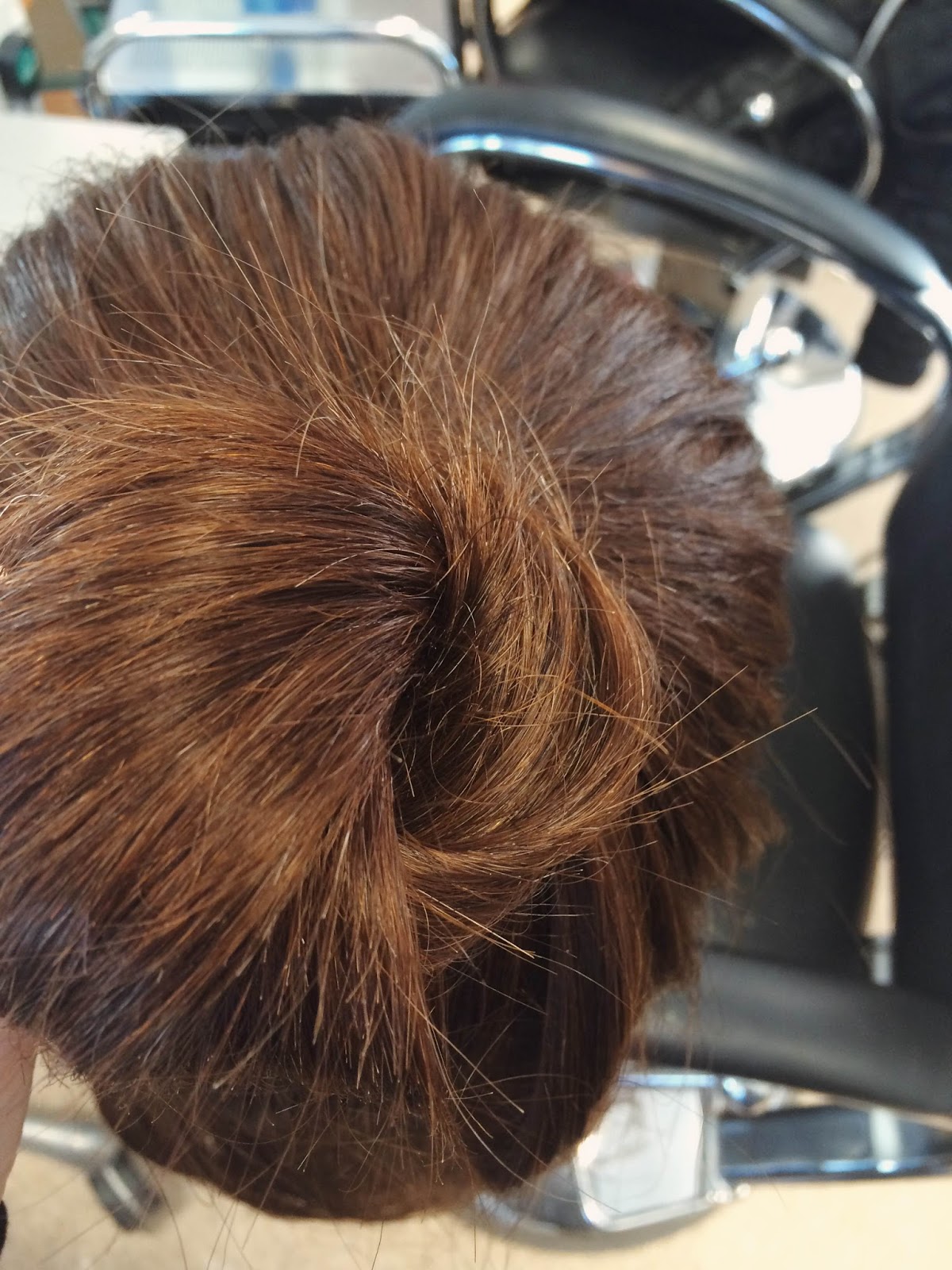
Twist Bun
The second hairstyle we were taught was a twist bun. This
was done using the same ponytail as previously used in the other bun. However
instead of backcombing the hair we brushed it through and then pulled the end
of the ponytail so it was taught from the elastic hair tie to the ends of the
hair. Then twisted the pony tail around, you could clearly see the spirals in
the hair. Then with the twisted pony tail we wound it around the base of the
pony tail, it formed a loop around the elastic band and I was able to secure it
in place using a Kirby grip and a straight pronged hair grip. This bun does not
look as neat as the previous bun and it wouldn’t be suitable for certain themes
or looks, in particular period hairstyles however if a messy up-do was required
I would feel confident in using a bun like this as it produced a messy look. I
also think it may have looked better if done using longer hair as the bun would
be larger.

Plait Bun
The third bun we were shown was created using a plait as the
bun. Again using the same ponytail as the base
we began to plait it. Once the plait had reached the ends of the hair
we were able to wrap it around the base of the pony tail. Once in a suitable
position I pinned it using hair grips. I found this particular style of bun a
lot harder to work with, as I found the plait was quite hard to shape into a
bun and for it to stay secured. However after some practice I feel it may
become easier for me to get the outcome that I would like to achieve.

Classic Plait

French Plait


Fishtail Plait
The final plait we were taught was a fishtail plait, one
that I have struggled with in the past when attempting it on myself or friends.
The process is simple however it is very time consuming, especially on longer
hair, which therefore means it would be unsuitable if a hairstyle needed to be
done quickly. To create the fishtail plait you need to brush through the hair
and make sure there are no nots or tangles as this will help the final look.
Then section the hair you wish to plait in two sections, with the same amount
of hair in each half. Then you take a small amount of hair from outer side of
one of the sections of hair and pass it over its original side and join it into
the other section. You then repeat the same thing however with the other
section of hair, again taking a small piece from the outside of a section of
hair. You must continue this for the full length of the hair and you must only
take small sections of hair. If you pass across larger sections it will not
look like a fishtail but sometimes like a normal plait. The process takes a
long time before you see any significant results however when creating a
fishtail plait you must persevere and eventually the look will come together.
These are also easily adapted for example you can make them look messy or neat
depending on the specific look you were trying to achieve.


Subscribe to:
Comments (Atom)